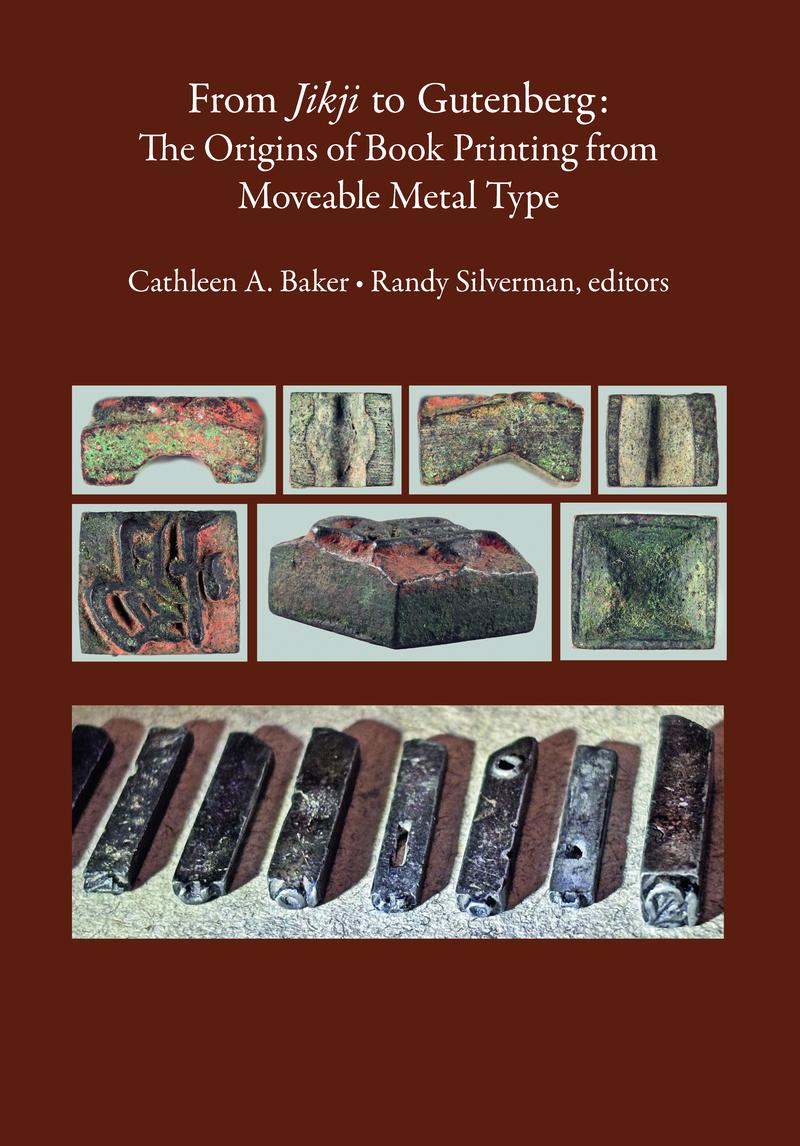
From Jikji to Gutenberg represents a preliminary investigation into the origins of moveable type and the first books printed from it in both the East and the West. When asked who was the ‘first book printer,’ people in the West usually answer ‘Johann Gutenberg’ of Mainz, Germany. And while his 42-line Bible (ca. 1454/55) is a masterwork and milestone among Western achievements, most grade-school children in South Korea can tell you that the Buddhist text, commonly referred to as Jikji, was printed from moveable metal type by monks in July 1377! Jikji is short for Baegun hwasang chorok buljo jikji simche yojeol [Anthology of Great Buddhist Priests’ Zen Teachings], and it was printed in the Heungdeok-sa temple in Cheongju. In 2001 in recognition of the technological achievement of moveable metal type, UNESCO inscribed both Jikji (the oldest extant East Asian book printed with metal type) and Gutenberg’s 42-line Bible on its Memory of the World International Register. In order to tell the origin story of these books, in 2020, the From Jikji to Gutenberg Project was formed, and after six years of discussion and collaboration, this book is offered as an introductory assessment of the surviving evidence surrounding humanity’s shared aspiration to print and publish books.
This book is published by The Legacy Press, Ann Arbor, Michigan, USA
This edition is distributed by Archetype Publications outside of the Americas.
Cathleen A. Baker and Randy Silverman, ‘Editors’ Notes and Acknowledgments; Randy Silverman, ‘Introduction’; Fackson Banda, ‘From Jikji to Gutenberg: How Understanding the Origins of Book Printing Can Promote International Cooperation in the Preservation and Accessibility of Documentary Heritage’; Jacob Nadal, ‘Histories of Making History’; Shin-Young Chung (with Ad Stijnman, Yeaseul Jung, and Young Kyun Oh), ‘Love Letter to Gutenberg’; Kim Ho-gui, ‘Jikji’; Seung-Cheol Lee, ‘About Jikji’; Cynthia Brokaw, ‘Premodern Chinese Print Technology and Book Culture’; Ok Young Jung, ‘Korean Woodblock and Wood-Type Printing’; Young Kyun Oh, ‘Printing Development and Korean Book Culture: What Did Koreans Do with Moveable Types?’; Ok Young Jung, ‘Technical Improvement and Development of Moveable Metal Types in the Early 15th Century of Joseon Dynasty’; Nam Kwon-Hee, ‘A Bibliographical Analysis of Editions of The Song of Enlightenment with Commentaries by Monk Nammyeong’; Nam Kwon-Hee, ‘Discovery of Goryeo Metal Type – “Jeungdoga Type” – and Its Scientific Analysis’; Dan Paterson, ‘The Korean Metal Movable Type at the Library of Congress’; Lars Kim, ‘Moveable Mysteries: Mapping Korean Type Collections across North America’; Jaeyong Chang and Hyoungbae Lee, ‘Korean Incunabula, 1377–1455’; Ji Young Park, ‘Ex Libris: A Translocational History of Jikji, the World’s Oldest Extant Book Printed with Moveable Metal Type’; Michael J. Seth, ‘Korea’s Place in the Premodern Trans-Regional Exchange Networks’; Jennifer Giaccai, S. Minhal Gardezi and Uwe Bergmann, ‘Technical Note on the Examination of Seven Arabic Block-Printed Amulets’; Arianna D’Ottone, ‘Multiple Impressions: Oriental and Arabic Printed Amulets’; Lee Oh-Kyu, ‘Jikji and Traditional Korean Paper, Hanji’; Shukhratillo Pulatov, ‘Papermaking in Central Asia from Samarkand to Kokand’; Timothy D. Barrett, ‘Observation on the Paper in the Gutenberg Bible’; Yun Yong-hyun, ‘The History and Manufacture of Korean Ink’; Ad Stijnman, ‘European and Asian Typographical Printing Inks, 1200–1600: A Comparison’; Minah Song, ‘Beyond the Object: Technological and Semantic Legacy in Korean Bound Books’; Eric Marshall White, ‘Gutenberg’s 42-line Bible and the Earliest Evidence of European Typography’; R. Stanley Nelson, ‘How Did Gutenberg Make His Printing Types?’; Jonathan Thornton, ‘Gutenberg Reconsidered: A Proposed Method for the Production of Early Cast-Metal Type in the West, Supported by Experimentation’; Jennifer Giaccai, ‘Technical Examination of Early Movable-Metal-Type Printed Books from Germany and Korea’; S. Minhal Gardezi, Nicholas P. Edwards, Michael B. Toth, Samuel M. Webb and Uwe Bergmann, ‘X-Ray Fluorescence Imaging of Early Moveable Type Print’; Nicholas P. Edwards, Elizabeth Ryan and Kristen St.John, ‘Protecting Collections during Synchrotron-Based XRF Imaging’; Elmer Eusman and Nancy Lev-Alexander, ‘Keeping It Cool: Creating the Library of Congress Gutenberg Bible Display Case’; Gary Frost, ‘Afterword: Page Fitting for a Small Planet’; bibliographies and index.